Rabu, 07 Juni 2017

Ebook Free San Diego Food Finds Best Local Eats: 2019, by Maria Desiderata Montana

Ebook Free San Diego Food Finds Best Local Eats: 2019, by Maria Desiderata Montana

It will certainly believe when you are visiting choose this publication. This impressive San Diego Food Finds Best Local Eats: 2019, By Maria Desiderata Montana publication could be reviewed totally in specific time depending on just how often you open up and review them. One to bear in mind is that every publication has their very own production to acquire by each visitor. So, be the great viewers as well as be a far better person after reviewing this book San Diego Food Finds Best Local Eats: 2019, By Maria Desiderata Montana

San Diego Food Finds Best Local Eats: 2019, by Maria Desiderata Montana

San Diego Food Finds Best Local Eats: 2019, by Maria Desiderata Montana


San Diego Food Finds Best Local Eats: 2019, by Maria Desiderata Montana


Ebook Free San Diego Food Finds Best Local Eats: 2019, by Maria Desiderata Montana

There are many suggestions that individuals provide to increase the life top quality, about every little thing. Right here, we additionally will certainly provide you a very simple suggestion to life better. Reading San Diego Food Finds Best Local Eats: 2019, By Maria Desiderata Montana is our tip. Please ask why we recommend this publication to check out. Lots of people attempt to make themselves to be abundant, however sometime they forget a really easy thing. Reviewing is in fact a basic point, yet several slouch to do it. It's sort of uninteresting activity and waste the time.

Waiting for releasing this publication is despite. It will certainly not make you really feel bored as exactly what you will really feel when awaiting somebody. It will certainly have lots of curiosity of how this publication is intended to be. When waiting a favorite book to read, one feeling that typically will take place wonders. So, what make you feel so curious in this San Diego Food Finds Best Local Eats: 2019, By Maria Desiderata Montana

San Diego Food Finds Best Local Eats: 2019, By Maria Desiderata Montana is a sort of publication with extremely amazing suggestions to realize. Just how the writer start to inspire you, just how the writer get the ideas to compose as this book, and just how the author has an amazing minds that provide you this incredible very easy publication to review. As we mentioned previously, the San Diego Food Finds Best Local Eats: 2019, By Maria Desiderata Montana truly includes something devoted. If you have such excellent and also objective to actually get to, this book can be the assistance to conquer it. You could not only get the knowledge pertaining to your job or duties currently. You will certainly get even more points.

If you still need more books San Diego Food Finds Best Local Eats: 2019, By Maria Desiderata Montana as referrals, visiting look the title and motif in this website is offered. You will certainly locate more whole lots publications San Diego Food Finds Best Local Eats: 2019, By Maria Desiderata Montana in various self-controls. You could additionally as quickly as possible to check out guide that is currently downloaded. Open it and conserve San Diego Food Finds Best Local Eats: 2019, By Maria Desiderata Montana in your disk or device. It will certainly ease you anywhere you need the book soft data to read. This San Diego Food Finds Best Local Eats: 2019, By Maria Desiderata Montana soft documents to read can be recommendation for everyone to boost the skill and also capacity.

San Diego Food Finds Best Local Eats: 2019, by Maria Desiderata Montana

Review

If you're searching for a travel reference that showcases San Diego's expansive culinary scene, look no further. Notable San Diego author and food writer Maria Desiderata Montana provides the inside scoop on the best places to eat in America's Finest City! Â -Chef Carl Schroeder, restaurateur, author of Market Restaurant + Bar Cookbook.

Read more

Product details

Paperback: 192 pages

Publisher: Maria Desiderata Montana (January 16, 2019)

Language: English

ISBN-10: 1946931039

ISBN-13: 978-1946931030

Product Dimensions:

6 x 0.5 x 9 inches

Shipping Weight: 12.3 ounces (View shipping rates and policies)

Average Customer Review:

Be the first to review this item

Amazon Best Sellers Rank:

#2,099,295 in Books (See Top 100 in Books)

San Diego Food Finds Best Local Eats: 2019, by Maria Desiderata Montana PDF
San Diego Food Finds Best Local Eats: 2019, by Maria Desiderata Montana EPub
San Diego Food Finds Best Local Eats: 2019, by Maria Desiderata Montana Doc
San Diego Food Finds Best Local Eats: 2019, by Maria Desiderata Montana iBooks
San Diego Food Finds Best Local Eats: 2019, by Maria Desiderata Montana rtf
San Diego Food Finds Best Local Eats: 2019, by Maria Desiderata Montana Mobipocket
San Diego Food Finds Best Local Eats: 2019, by Maria Desiderata Montana Kindle

San Diego Food Finds Best Local Eats: 2019, by Maria Desiderata Montana PDF

San Diego Food Finds Best Local Eats: 2019, by Maria Desiderata Montana PDF

San Diego Food Finds Best Local Eats: 2019, by Maria Desiderata Montana PDF

Sabtu, 03 Juni 2017

Free Download The Third Teacher

Free Download The Third Teacher

That's a typical problem. To overcome this consists of, exactly what should do? Reviewing a book? Definitely? Why not? Book is just one of the resources that many people depend on of it. Even it will certainly depend upon guide type and title, or the writer; books constantly have favorable thoughts and minds. The Third Teacher is among the options for you making you looking forward for your life. As known, reviewing will lead you for a better method. The manner in which you take obviously will be analogously with your situation.

The Third Teacher

The Third Teacher


The Third Teacher


Free Download The Third Teacher

Many people are attempting to be smarter on a daily basis. How's concerning you? There are lots of ways to evoke this case; you can discover knowledge and lesson almost everywhere you want. Nonetheless, it will certainly involve you to get exactly what call as the preferred thing. When you need this type of resources, the adhering to publication can be a fantastic choice. The Third Teacher is the title of the book,

The service to get this book is that we don't over you the complimentary book. However, we provide you the totally free information regarding The Third Teacher Why should be this publication to read and where is the place to obtain it, even the soft file types are common concerns to utter. In this internet site, we do not just provide this book. We have still lots of books to review. Yeah, we are internet collection that is always loaded with advised books.

You may not should be question regarding this The Third Teacher It is not difficult means to obtain this publication The Third Teacher You can simply see the distinguished with the web link that we supply. Here, you could buy the book The Third Teacher by on the internet. By downloading and install The Third Teacher, you can locate the soft data of this publication. This is the exact time for you to start reading. Even this is not published publication The Third Teacher; it will specifically offer more perks. Why? You might not bring the printed book The Third Teacher or only pile guide in your house or the workplace.

When selecting this The Third Teacher to obtain and also review, you will certainly start it from the initial web page as well as make bargain to love it a lot. Yeah, this publication truly has great condition of guide to review. How the writer attract the visitors is extremely smart. The web pages will show you why the book is presented for the fantastic people. They will certainly concern you to be one that is better in undergoing the life as well as improving the life.

The Third Teacher

About the Author

The Third Teacher is a collaboration between OWP/P Architects, VS Furtniture, and Bruce Mau Design. OWP/P Architects has offices in Chicago and Phoenix and has worked with more than 150 school clients to support their educational vision. VS Furniture is a 110-year-old manufacturer of educational furnishings based in Germany. Bruce Mau Design is a business and cultural design studio with offices in Toronto and Chicago.

Read more

Product details

Paperback: 254 pages

Publisher: Abrams; 1st edition (April 1, 2010)

Language: English

ISBN-10: 9780810989986

ISBN-13: 978-0810989986

ASIN: 0810989980

Product Dimensions:

7.2 x 1 x 10 inches

Shipping Weight: 2 pounds (View shipping rates and policies)

Average Customer Review:

4.2 out of 5 stars

34 customer reviews

Amazon Best Sellers Rank:

#112,364 in Books (See Top 100 in Books)

I bought this book for my education methods class before student teaching. I love the layout of the book, very attractive layout! Easier to read, since the text is not in the typical textbook format. The only problem with this book is the binding. The pages started falling out before I was through the first chapter. I took the book to Staples, and they spiral bound it for about $6.

Great overview of the progressive thinking in education. A bit unrealistic argument/expectation that new schools should be build to fulfill the requirements of proper learning environment. Limited concentration on how to retrofit already existing physical structures/schools in a relatively fiscally responsible way to fit all those listed requirements. Dreaming is great, but reality requires different kind of invention. Maybe next book will tackle that.

This book was unbelievably insightful. As masters student in architecture working on my thesis I found it extremely helpful for classroom design and creative space design. I also greatly appreciated the strong graphics which showed there was a holistic design approach to the book in general.

A good work, something i would recommend for anyone interested in redesign their approach to education.

I bought this book for a final paper I had to do and let me tell you it was the best money I had spend all semester. GOOD BOOK. GOOD INFORMATION. AWESOME VISUALS. This book has from top to bottom DESIGN written all over it. From the lettering to the images everything is awesome and interesting. love it :)

The book reads very easily. It doesn't take long time get through. It is becoming dated. Many of the concepts have been incorporated.

When you hear the title third teacher it doesn't really make you think of the environment, it seems like it will tell us how to make teaching easuer.

Need more illustrations to show the ideasSome are very simple but useful concepts butNot immediately for practical school designers

The Third Teacher PDF
The Third Teacher EPub
The Third Teacher Doc
The Third Teacher iBooks
The Third Teacher rtf
The Third Teacher Mobipocket
The Third Teacher Kindle

The Third Teacher PDF

The Third Teacher PDF

The Third Teacher PDF

Kamis, 04 Mei 2017

Free Ebook 48 Hours

Free Ebook 48 Hours

Reading a book is additionally sort of much better solution when you have no sufficient money or time to get your personal experience. This is among the factors we reveal the 48 Hours as your buddy in investing the moment. For more representative collections, this publication not just supplies it's tactically book source. It can be a buddy, really good friend with much knowledge.

48 Hours

48 Hours


48 Hours


Free Ebook 48 Hours

48 Hours Just how can you alter your mind to be a lot more open? There numerous sources that could assist you to boost your thoughts. It can be from the various other encounters as well as story from some individuals. Reserve 48 Hours is among the trusted sources to get. You can find so many books that we discuss below in this web site. And also currently, we reveal you among the most effective, the 48 Hours

Why should be this book 48 Hours to read? You will never get the expertise and also experience without obtaining by yourself there or trying on your own to do it. For this reason, reading this publication 48 Hours is required. You can be fine and also proper adequate to obtain just how vital is reading this 48 Hours Also you constantly check out by responsibility, you can assist on your own to have reading e-book habit. It will certainly be so helpful and also fun then.

And also how this book will aid you? Do you believe that you have issue with comparable subject? This is no stress over this. Even you have had the resources to resolve your troubles; this publication will complete just what you require. 48 Hours is one of the books that that has been written by the trusted author. With the experience, expertise, as well as realities that are used by this book, it is truly professional.

Don't worry, the material is same. It could exactly make easier to review. When you have the published one, you should bring that product as well as fill up the bag. You could likewise really feel so tough to locate the published publication in the book store. It will certainly waste your time to go with walking onward to guide shop and search the book racks by shelfs. It is among the advantages to take when selecting the soft file 48 Hours as the option for reading. This set could assist you to optimize your cost-free or leisure for everyday.

48 Hours

Product details

#detail-bullets .content {

margin: 0.5em 0px 0em 25px !important;

}

Audible Audiobook

Listening Length: 11 hours and 11 minutes

Program Type: Audiobook

Version: Unabridged

Publisher: Blackstone Audio, Inc.

Audible.com Release Date: January 8, 2019

Whispersync for Voice: Ready

Language: English, English

ASIN: B07M93YPPH

Amazon Best Sellers Rank:

I’ve read all of William Fortschen’s books. They’re among the best of apocalypse fiction, a genre dominated by potboilers, so naturally, I preordered this book. My big question was if the author could write something new, especially since at first glance it appears the apocalypse in "48 Hours" is very similar to the EMP found in Fortschen’s most famous book, "One Second After." Without giving the story away, I can tell you this book is quite original. And to me, the most interesting matter that Fortschen covers, indeed the plot driver of the entire book, relates to a long-running apocalypse concern of mine. Namely, that the government, at any level, is not our friend, and would be our enemy in any real crisis where someone has to lose.It’s entirely obvious, upon a moment’s reflection, that in any crisis today, whether a pandemic that requires medicine, a nuclear attack that requires shelter, a famine that requires food, or an alien attack where the aliens demand human flesh to eat, that our rulers would save themselves and their cronies first, along with, to the extent possible, their own property, and certainly, as much as possible, their own power. I think this is mostly a new thing, the result of the rot of our ruling classes, including the disappearance of duty, virtue, and noblesse oblige George Washington wouldn’t save himself first, but I am certain that both Donald Trump and Hillary Clinton would (the latter more certainly than the former). Oh, sure, they’d make noises about how important it was that there be “continuity of government,” and that it was all for the future greater good, but the reality is that they’d make sure they got theirs, and so would their friends.And it’s not just the President. For no reason I can comprehend, other than naked self-interest, Congress strongly believes that saving Congress is regarded as important, so they, their families, their staffers, and their hangers-on would get to the front of the line. Bureaucrats of all stripes, the poisonous fruit of the grasping administrative state, would also get served first. After all, how could we live without a fully staffed EEOC? And it’s not just the federal government; as Fortschen paints a vivid picture, it would be state governments as well. Not to mention that local governments would also get in on the act. Municipal governments mostly wouldn’t have bunkers or stockpiled food (although I bet New York and Chicago do, hidden and reserved for Bill de Blasio and Rahm Emanuel, along with their toadies). But I’m pretty certain, for example, that if the food ran out, in most municipalities the city government, allied with the police, would use the military equipment that the federal government has stupidly handed out, to go around collecting food and medicine “for equitable distribution.” Which is one reason I occasionally run the thought experiment of how to deal with the armored personnel carrier my local police department operates. Did you know that modern APC’s can be easily pierced by standard .50 caliber rounds? I didn’t.It’s unfortunate that today government is not to be trusted. Perhaps it never could have been trusted, but the difference today is that the government has enormously more power. Power to know what’s coming, power to build to protect the people who control it, power to defend what it builds. But that’s where we are, and at least the view of government as the enemy in a zero-sum crisis is something that people all across the political spectrum can get behind, although conservatives and libertarians are probably more inclined to this realization. That is, it might take liberals more time to realize that when government workers and their families go to the front of the line, that there won’t be a back of the line, whatever promises are being made. And those promises would be made—and perhaps even believed, because history shows that average people will swallow almost any story if accepting it makes them able to put off the choice to fight. A strange inertia seems to overcome most people. Rather than shooting their way to the front of the line when the fat EPA clerk waddles, along with his family and cousins, back into the “Government Workers Only” food line for seconds, then thirds, they’ll more likely wait for the promised crumbs to be dribbled to them through the barbed-wire-topped fence. That’s stupid. Shoot first.I suppose you can’t really blame government workers for putting themselves at the front. It’s a natural human response, after all. Self-sacrifice to benefit others is largely, or exclusively, a Western concept derived from Christianity, and an aspirational one at that. For example, during famines in China, including those caused by Mao, it was common for parents to kill and eat their children (although often by swapping their children with others’, so they didn’t have to do it themselves), something essentially inconceivable in the West, though perhaps not any longer in these post-Christian days. The same thing happens in North Korea today, and I suspect would be true of any culture that is not Christian (or Jewish or Muslim, who have a similar self-sacrificing ethos, though without the applicable-to-everyone demand of the Golden Rule). Why is it inconceivable to us, though, given that sacrificing others makes utilitarian sense? It’s because of our superior culture, where parents would rather die that contemplate such an action, and everyone knows his duty is to take one for the team. But I don’t think this principle extends, at least today, to limit governmental self-dealing in a crisis where someone has to lose—and that’s what this book illustrates with dramatic impact.I don’t think that this is necessarily an argument for a minimalist state. True, certainly, the state we have now is terrible, and a minimalist state would solve the problem of self-dealing by our ruling class in a crisis. But I am not a libertarian; the governmental structure I would prefer is not one that necessarily maximizes personal liberty, certainly not in the way of modern “liberal democracy,” but a strong state based on principles of practicality and virtue—strong, that is, in those few areas that matter, and either non-existent in most areas of life, or based around rigorous principles of subsidiarity in any matters not essential to the central government. Albert Jay Nock would hate my vision of government, but he would entirely agree with my point about modern governmental self-protection in crises.Still, even my Augustan-type state would be susceptible to this problem, of the human beings who make up government acting purely in their own self-interest. Our governmental heroes, or those who used to be our governmental heroes, like George Washington, were exceptional men. In more recent times, I suppose, there are examples of leaders in government who refused to exempt themselves from risks faced by the common people, such as Churchill and King George VI staying in London during the Blitz, or even Stalin refusing to leave Moscow in 1941 (though he kept his fast train ready). But you can’t get exceptional men, reliably at least, without a virtuous society to generate them, and so getting that society is the key to solving the problem. I can’t think of any self-sacrificing or risk taking by any member of a Western government in many decades, but I can remember the entire United States government scurrying like rats to protect themselves on 9/11, and then turning Washington, and every federal building in the universe, into a fortress, at the cost of hundreds of billions, while grabbing massive amounts of fresh power for themselves. Maybe I’d be surprised by how our government reacted in a crisis. But I doubt it.You won’t feel good when you’ve finished this book. But you’ll have learned something that may be very useful to you someday, that those who should protect us will do nothing of the sort, so it’s probably worth doing.

I love this genre. When I read the book summary I literally thought, "Game on!" and bought it immediately. I loved the One Second After series so I knew I liked the author so it was a no brainer. I bought it for my Kindle so I don't know what page I'm on officially, but I am around 47% of the way through the book and just... stopped reading.I was immediately disappointed because the book opens after the first CME hits, so I felt misled considering the summary I read: In 48 hours, the Earth will be hit by a Coronal Mass Ejection (CME) from the Sun, a "Carrington Event" that has the power to shut down and possibly destroy the world's electrical infrastructure. To try and prevent permanent damage, everything goes dark prior to the hit: global communications are shut down; hospital emergency generators are disconnected; the entire internet, media broadcasting, and cell phone systems are turned off.To me the summary made it sound like we would get to see the very beginning of shutting things down, but no. Things have been down for weeks when the story opens and it's another CME that's coming to cause more damage. Okay, no biggie I'll keep going it still sounds cool.I hated the use of all things military in this book (so far). It just seems shoved down our throats like "look at all these military things we know" especially calling Afghanistan "the 'Stan". It was just awkwardly inserted. Also apparently three tours there make you an expert in everything military and makes you excellent in everything even though it doesn't seem he gets any specialized training. Then his wife, whose father owned a specialty gun shop (I think it's said they did additions and personalization to guns) that she inherited, is some kind of ninja who routinely gets called away on secret missions for weeks at a time with top secret clearances and sat phones. So apparently gun shop owners can be commandos just because they own a gun shop? I can buy she's a crack shot, but everything else just seems crazy. At least give us some back story as to how she got into that and have it make some sense.I was so excited about this book because in addition to loving apocalypse stories I love all things astronomy. I was so excited to get quite a bit of science in this book when they were explaining the solar events. But then they just kept explaining the events... and explaining... and explaining. One of the scientists sits in with the president a few times doing most of the explaining and re-explaining. Then after discussing how all of this radiation was likely to kill everyone and everything the president was suddenly shocked when the scientist mentioned the fall out after the event is over and how it can continue to kill people, animals, etc and keep them from easily coming back. I mean, hello! Radiation? Of course it has long term affects on life in the area. Isn't this after the A-bombs have been dropped? Don't we know that things are really bad even after the initial blast? How is the damn president (who has been dealing with this for at least a month now) shocked by this? Then, of course, we get even more explanations.The part that did me in, though, is how Darren and Darla (the main characters) are now taking over Darren's place of employment. He conveniently works at an underground cave that houses an enormous amount of food and other supplies which of course is being prepped for higher ranking officials and their families to come seek shelter. Darren and Darla disapprove (not that they're wrong about that) and decide to wrangle up Darren's former deputy (who they compared to Barney Fife with Barney winning the comparison mind you), the pastor at their church that was never mentioned before this, and a handful of church deacons.So these people decide they are going to take the place over. They bring their handful of cars (I don't remember 3-6 vehicles) drive into the place and with a few guns pointed at the on site leader they take over the base. I just don't get it. Darren even has the audacity to get pissed at the leader when he says something impolite to his poor wife while she is going on her holier than thou tirade.They are going to fill the cave with kids along with some teachers and medical staff, not the parents or anything. So these kids are going to come out knowing how to re-seed the area so they can grow food, right? Doubtful. I would bet the government would have people whose sole purpose is to make things inhabitable when this is over. I can understand wanting save all the kids, but damn at least give them the help they need to survive when they run out of food in the cave.I'm hoping it gets better, but I'm not holding hope. I'll keep plodding along for now. Hopefully I'll update this soon with a completely changed mind.

I've enjoyed some of his other books, but this one is awful.The book badly needs editing. It's extremely repetitive and even pedantic. The "pedantic" part is an unusual criticism from me, because personally, professionally, and in my casual reading adventures, I am an unapologetic science geek. It's nearly impossible to turn me off with technical details, but somehow this book manages it, because the descriptions and explanations drone on. and on. and on.The main characters are cliches, and are not at all developed - there's a flatness and sameness to them, so it's impossible to engage with them or care what happens to them. He seems to use the characters to deliver lectures about his personal social and spiritual perspectives, and this comes across overall in a tedious and self-righteous manner. If that weren't enough, there are lengthy sections of the book, presented as 'asides' in italics, that he uses as a vehicle for even MORE awkward philosophizing and sermonizing. I'm sorry, but it's all just awful.The story is based on a great idea which could have led to an absolute stunner of a novel. The implications are so profound that a well-crafted story would highlight them without any need to lecture the reader. The practical, moral, and spiritual challenges would be real and compelling, and readers don't need the author to pedantically moralize at them. A great story gently persuades the reader to consider difficult questions. This one just repeatedly hits you over the head with the authors' own biases - your own thoughts about issues raised by the story don't matter. I regret this purchase.

48 Hours PDF
48 Hours EPub
48 Hours Doc
48 Hours iBooks
48 Hours rtf
48 Hours Mobipocket
48 Hours Kindle

48 Hours PDF

48 Hours PDF

48 Hours PDF
48 Hours PDF

Minggu, 23 April 2017

Download Ebook Poor Little Rich Girl: The Life and Legend of Barbara Hutton, by C. David Heymann

Download Ebook Poor Little Rich Girl: The Life and Legend of Barbara Hutton, by C. David Heymann

This location is an online publication that you could discover and also appreciate many kinds of publication brochures. There will certainly come numerous distinctions of how you find Poor Little Rich Girl: The Life And Legend Of Barbara Hutton, By C. David Heymann in this web site and also off collection or the book stores. Yet, the significant reason is that you could not go for lengthy moment to seek for guide. Yeah, you should be smarter in this modern period. By innovative technology, the on-line collection and also store is supplied.

Poor Little Rich Girl: The Life and Legend of Barbara Hutton, by C. David Heymann

Poor Little Rich Girl: The Life and Legend of Barbara Hutton, by C. David Heymann


Poor Little Rich Girl: The Life and Legend of Barbara Hutton, by C. David Heymann


Download Ebook Poor Little Rich Girl: The Life and Legend of Barbara Hutton, by C. David Heymann

What kind of checking out book are you searching for now? If you are actually fond of the subject similar to Poor Little Rich Girl: The Life And Legend Of Barbara Hutton, By C. David Heymann, you can take it directly here. This publication is in fact an usual publication. However, how the author obtain the words to create this book is so amazing. You could not locate anything special from the cover and the title of the book, but you could obtain everything special from the book after read.

As we stated previously, the technology assists us to consistently identify that life will certainly be always much easier. Reading e-book Poor Little Rich Girl: The Life And Legend Of Barbara Hutton, By C. David Heymann practice is also among the perks to obtain today. Why? Technology could be utilized to give guide Poor Little Rich Girl: The Life And Legend Of Barbara Hutton, By C. David Heymann in only soft file system that could be opened every time you desire and almost everywhere you require without bringing this Poor Little Rich Girl: The Life And Legend Of Barbara Hutton, By C. David Heymann prints in your hand.

Are you considering mainly books Poor Little Rich Girl: The Life And Legend Of Barbara Hutton, By C. David Heymann If you are still confused on which of the book Poor Little Rich Girl: The Life And Legend Of Barbara Hutton, By C. David Heymann that need to be purchased, it is your time to not this website to search for. Today, you will require this Poor Little Rich Girl: The Life And Legend Of Barbara Hutton, By C. David Heymann as the most referred book and also the majority of needed book as resources, in other time, you can appreciate for other books. It will rely on your willing requirements. But, we always recommend that publications Poor Little Rich Girl: The Life And Legend Of Barbara Hutton, By C. David Heymann can be a great infestation for your life.

It will direct you to make or come to be someone better. Priceless times for reading is acquired because you don't lose the moment for something problem. When you really read this publication carefully and perfectly, exactly what you seek fro will be eventually gotten. To get Poor Little Rich Girl: The Life And Legend Of Barbara Hutton, By C. David Heymann in this short article, you have to obtain the web link. That is the link of the book to download. When the soft file of guide can help you easier, why not you make an opportunity to get this book now? Be the first individuals that get this book here!

Poor Little Rich Girl: The Life and Legend of Barbara Hutton, by C. David Heymann

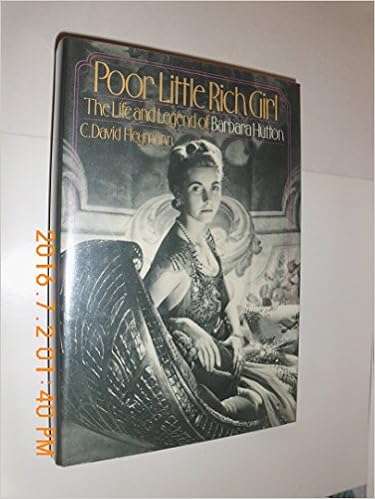
In her lifetime, the wealth and glamour of the Woolworth heiress Barbara Hutton were legendary. Her much-publicized and extravagant lifestyle encompassed lavish parties, seven marriages and many affairs, and her name was constantly linked with film stars and royalty. But there was another side to her life that remained shrouded in mystery for all but a close circle of friends. This was Barbara Hutton the alcoholic, the anorexic, the woman who misused drugs and money, dissipating a huge fortune before her lonely death in 1979. This biography, which makes use of her diaries, letters and journals, is published to tie in with a TV dramatization of her life, starring Farah Fawcett.

Read more

Product details

Hardcover: 399 pages

Publisher: Random House Inc (November 1, 1983)

Language: English

ISBN-10: 0394509420

ISBN-13: 978-0394509426

Package Dimensions:

3.7 x 3.6 x 0.7 inches

Shipping Weight: 1.8 pounds

Average Customer Review:

4.0 out of 5 stars

24 customer reviews

Amazon Best Sellers Rank:

#422,040 in Books (See Top 100 in Books)

Heymann left no stone unturned in this very detailed autobiography of the puzzling creature the world came to know as the "poor little rich girl" - Woolworth heiress Barbara Hutton. Our favorite portion of the book occurs when a dinner companion candidly asks the socialite how it feels to be the world's richest woman - her answer is forthright and simply wonderful. Heymann's attention to details, names and places may have your head spinning at times...this is the kind of book that demands your full attention and is best devoured in small bites. You're gonna need a scorecard to pay attention to Hutton's husbands, lovers and ways to spend money!

This was a sad recounting of a troubled life, which is evidence that money cannot buy happiness. As heiress to the Woolworth fortune, Barbara Hutton was one of the wealthiest women in the world. She lost her mother at the age of five and didn’t ever seem to have anyone who really looked out for her. Her seven marriages ended in divorce. One of her greatest losses was the death of her only son. With the exception of Cary Grant, all her husbands apparently were only after her money, and she obliged them. In spite of her immense wealth, she looked many years older when she reached her sixties. This was no doubt due in large part to her excessive drinking, smoking and use of drugs.She did not always behave in an exemplary manner; however, she did have some wonderful qualities, not the least of which was her generosity. Not only did she give generously to her husbands and boyfriends, but also she gave to her servants and others when she saw they were in real need.I enjoyed reading this book and think most people who like biographies will as well.

I'm about halfway through the book, but I was surprised to find out that there is a lot TO this famous woman besides her indulgences in the privileges (and travails) that go with having tons of money. She was bright, imaginative and an astute observer. A big part of the book is based on journals that she kept throughout her life, and her accounts are detailed, well-written, and hugely interesting - they provide a great commentary on the culture and the times that she lived in. And she is much more forthright about the details of her intimate relationships than I ever would have expected. She was certainly no prude! The book also includes nice photos of some of the significant people in her life - some of them. As you know, there were so many!

While I skimmed a few parts that didn't interest me, I generally was entertained andinterested in Hutton's life. In some ways it was a fascinating escape into the landof the waaay too rich!

excellent

very pleased

I enjoyed this book. She really was a "poor little rich girl". Always searching for someone to love her.

This book proves money can't buy happiness, especially when you don't earn it yourself. It's fascinating to see how the really wealthy lived, especially during that time!

This was a very well written book chocked full of information. Hutton was definitely a poor little rich girl and at times it was hard to see her completely throw her life away.

Poor Little Rich Girl: The Life and Legend of Barbara Hutton, by C. David Heymann PDF
Poor Little Rich Girl: The Life and Legend of Barbara Hutton, by C. David Heymann EPub
Poor Little Rich Girl: The Life and Legend of Barbara Hutton, by C. David Heymann Doc
Poor Little Rich Girl: The Life and Legend of Barbara Hutton, by C. David Heymann iBooks
Poor Little Rich Girl: The Life and Legend of Barbara Hutton, by C. David Heymann rtf
Poor Little Rich Girl: The Life and Legend of Barbara Hutton, by C. David Heymann Mobipocket
Poor Little Rich Girl: The Life and Legend of Barbara Hutton, by C. David Heymann Kindle

Poor Little Rich Girl: The Life and Legend of Barbara Hutton, by C. David Heymann PDF

Poor Little Rich Girl: The Life and Legend of Barbara Hutton, by C. David Heymann PDF

Poor Little Rich Girl: The Life and Legend of Barbara Hutton, by C. David Heymann PDF

Jumat, 07 April 2017

Download PDF The Mind-Changing Habit of Journaling: The Path To Forgive Yourself For Not Knowing What You Didn’t Know Before You Learned It - A Guided Journal for Self-Exploration and Emotional Healing, by Zoe McKey

Download PDF The Mind-Changing Habit of Journaling: The Path To Forgive Yourself For Not Knowing What You Didn’t Know Before You Learned It - A Guided Journal for Self-Exploration and Emotional Healing, by Zoe McKey

This book is very proper for the book theme that you are seeking now. Many resources might provide the selection, yet The Mind-Changing Habit Of Journaling: The Path To Forgive Yourself For Not Knowing What You Didn’t Know Before You Learned It - A Guided Journal For Self-Exploration And Emotional Healing, By Zoe McKey can be the best method. It is not only one thing that you could delight in. Extra things and lessons are offered or you to cover what you specifically require. Numerous visitors need to read the books likewise due to the particular factors. Some may love to read it a lot yet some could require it since the job target date.

The Mind-Changing Habit of Journaling: The Path To Forgive Yourself For Not Knowing What You Didn’t Know Before You Learned It - A Guided Journal for Self-Exploration and Emotional Healing, by Zoe McKey

The Mind-Changing Habit of Journaling: The Path To Forgive Yourself For Not Knowing What You Didn’t Know Before You Learned It - A Guided Journal for Self-Exploration and Emotional Healing, by Zoe McKey


The Mind-Changing Habit of Journaling: The Path To Forgive Yourself For Not Knowing What You Didn’t Know Before You Learned It - A Guided Journal for Self-Exploration and Emotional Healing, by Zoe McKey


Download PDF The Mind-Changing Habit of Journaling: The Path To Forgive Yourself For Not Knowing What You Didn’t Know Before You Learned It - A Guided Journal for Self-Exploration and Emotional Healing, by Zoe McKey

Do not change your mind when you are starting to plan to have analysis habit. This routine is a good as well as great behavior. You need to enliven it with the most effective books. Numerous publications show and provide there extraordinary content based upon each styles as well as subjects. Also each publication has different taste of creating; they will certainly offer better problem when checked out quite possibly. This is what makes us proudly existing The Mind-Changing Habit Of Journaling: The Path To Forgive Yourself For Not Knowing What You Didn’t Know Before You Learned It - A Guided Journal For Self-Exploration And Emotional Healing, By Zoe McKey as one of guides to read currently.

This publication The Mind-Changing Habit Of Journaling: The Path To Forgive Yourself For Not Knowing What You Didn’t Know Before You Learned It - A Guided Journal For Self-Exploration And Emotional Healing, By Zoe McKey is expected to be one of the very best seller publication that will certainly make you really feel completely satisfied to purchase and review it for finished. As recognized could common, every publication will certainly have specific points that will certainly make an individual interested a lot. Also it originates from the author, kind, material, and even the author. However, lots of people likewise take the book The Mind-Changing Habit Of Journaling: The Path To Forgive Yourself For Not Knowing What You Didn’t Know Before You Learned It - A Guided Journal For Self-Exploration And Emotional Healing, By Zoe McKey based upon the style as well as title that make them surprised in. as well as below, this The Mind-Changing Habit Of Journaling: The Path To Forgive Yourself For Not Knowing What You Didn’t Know Before You Learned It - A Guided Journal For Self-Exploration And Emotional Healing, By Zoe McKey is very advised for you because it has interesting title as well as motif to check out.

Whatever your problem, reading will certainly constantly give you simple scenario to be much fun. Yeah, the home entertainment book will certainly reveal you its power making people feel happy and laugh. The social book will provide you new knowledge daily about this life and social connection. Politics and also religious, something is very big currently. It is likewise regarding how the people will honour publication, every type of book as the referred analysis product. We could start it from the The Mind-Changing Habit Of Journaling: The Path To Forgive Yourself For Not Knowing What You Didn’t Know Before You Learned It - A Guided Journal For Self-Exploration And Emotional Healing, By Zoe McKey

Be various with other people who don't read this book. By taking the good benefits of reading The Mind-Changing Habit Of Journaling: The Path To Forgive Yourself For Not Knowing What You Didn’t Know Before You Learned It - A Guided Journal For Self-Exploration And Emotional Healing, By Zoe McKey, you can be important to spend the moment for checking out various other publications. As well as below, after getting the soft fie of The Mind-Changing Habit Of Journaling: The Path To Forgive Yourself For Not Knowing What You Didn’t Know Before You Learned It - A Guided Journal For Self-Exploration And Emotional Healing, By Zoe McKey and serving the link to give, you could likewise find other book collections. We are the most effective area to seek for your referred book. As well as currently, your time to get this publication as one of the compromises has prepared.

The Mind-Changing Habit of Journaling: The Path To Forgive Yourself For Not Knowing What You Didn’t Know Before You Learned It - A Guided Journal for Self-Exploration and Emotional Healing, by Zoe McKey

Product details

Paperback: 282 pages

Publisher: Independently published (February 15, 2019)

Language: English

ISBN-10: 1796860719

ISBN-13: 978-1796860719

Product Dimensions:

5 x 0.6 x 8 inches

Shipping Weight: 13.3 ounces (View shipping rates and policies)

Average Customer Review:

5.0 out of 5 stars

5 customer reviews

Amazon Best Sellers Rank:

#55,558 in Books (See Top 100 in Books)

Why journaling? I asked myself when I saw this book. Isn’t that something teenagers do when they are in love or are in a mean mode? But something pushed me to check this book out. And I’m so happy I did.The book is not empty lines with a cluster of quotes but an actual actionable guide to deconstructing and healing life-long limiting beliefs you have of yourself. Zoe, very vulnerably, shares her personal path on the subject. Her examples are surprisingly relatable even though we come from so different backgrounds. Every page I felt at least once, “hey, that’s me too” , “I do or did that too”, “I want to know that too.”And here comes the best part, she tells you how you can find the answers, heal the wounds and understand yourself - through journaling practices. Even better, she offers a free printable journal to guide you through the exercises. All I had to do was downloading this file (its word format so its editable on the computer), read the book and fill out the exercise sheets. Wow… some stuff really hit me. I mean, I kind of sort of knew some of these things about myself but they didn’t make any sense until I sat down and wrote about them in a specific context. It’s different having something on the back of your mind or in front of your eyes, folks.She separates her self-discovery journaling process into 4 steps, each building upon the other one. All in all it is a useful book. A helpful one. Many times I feel “oh, this was a good book but not particularly helpful”. Well this one is both.

Very thorough overview to the benefits of journaling - in particular how this form of introspection can alter our method of thinking. Wonderful read!

I liked how the chapters in this book were broken down into steps. Each step was focused on a specific topic. Awareness, transformation, etc. Each step is then elaborated on by deep diving into the topic. Thorough explanations and examples are set forth which was beneficial to me as I am new to and still learning about Journalling.

This book truly touched me as I could relate with the author's struggles, discovery processes and conclusions quite a bit. The book was divided into four sections, each section talking about a step in one's self-discovery journey. Each of these steps I found crucial - awareness, understanding, non-blaming, self-empathy and forgiveness and in the end honest embracing of oneself. The author had a way with her words and conveyed her message in a vulnerable and authentic way. I enjoyed the read and the printable journal attached was super helpful.

This book gave me so much emotionally. The author talks about her self-transformation journey with brutal honesty and reminds us we are all people who struggle to deal with many of the same day to day issues.We are not alone and we are not weak. Are we going to get knocked down from time to time, yes we will, but she reminds us that when we get back up and learn from those lessons we'll get out as a much better versions of ourselves on the other side.Hold on to your wishes to become better, whatever they may be, stop convincing yourself that you can't do it! Don't let your negative thoughts, society or any individual take those hopes away. You need to take care of yourself!! We often have so many others who are looking to us to help take care of them and we can't do that if we don't take care of ourselves.A quick and motivating read. I am sure I will read it again, not only because I can relate to her stories, but also to be reminded of that motivation she provides.

The Mind-Changing Habit of Journaling: The Path To Forgive Yourself For Not Knowing What You Didn’t Know Before You Learned It - A Guided Journal for Self-Exploration and Emotional Healing, by Zoe McKey PDF
The Mind-Changing Habit of Journaling: The Path To Forgive Yourself For Not Knowing What You Didn’t Know Before You Learned It - A Guided Journal for Self-Exploration and Emotional Healing, by Zoe McKey EPub
The Mind-Changing Habit of Journaling: The Path To Forgive Yourself For Not Knowing What You Didn’t Know Before You Learned It - A Guided Journal for Self-Exploration and Emotional Healing, by Zoe McKey Doc
The Mind-Changing Habit of Journaling: The Path To Forgive Yourself For Not Knowing What You Didn’t Know Before You Learned It - A Guided Journal for Self-Exploration and Emotional Healing, by Zoe McKey iBooks
The Mind-Changing Habit of Journaling: The Path To Forgive Yourself For Not Knowing What You Didn’t Know Before You Learned It - A Guided Journal for Self-Exploration and Emotional Healing, by Zoe McKey rtf
The Mind-Changing Habit of Journaling: The Path To Forgive Yourself For Not Knowing What You Didn’t Know Before You Learned It - A Guided Journal for Self-Exploration and Emotional Healing, by Zoe McKey Mobipocket
The Mind-Changing Habit of Journaling: The Path To Forgive Yourself For Not Knowing What You Didn’t Know Before You Learned It - A Guided Journal for Self-Exploration and Emotional Healing, by Zoe McKey Kindle

The Mind-Changing Habit of Journaling: The Path To Forgive Yourself For Not Knowing What You Didn’t Know Before You Learned It - A Guided Journal for Self-Exploration and Emotional Healing, by Zoe McKey PDF

The Mind-Changing Habit of Journaling: The Path To Forgive Yourself For Not Knowing What You Didn’t Know Before You Learned It - A Guided Journal for Self-Exploration and Emotional Healing, by Zoe McKey PDF

The Mind-Changing Habit of Journaling: The Path To Forgive Yourself For Not Knowing What You Didn’t Know Before You Learned It - A Guided Journal for Self-Exploration and Emotional Healing, by Zoe McKey PDF

Selasa, 04 April 2017

Get Free Ebook Manuscript Jokes Copywork 1: Write and Laugh (Volume 2)

Get Free Ebook Manuscript Jokes Copywork 1: Write and Laugh (Volume 2)

Manuscript Jokes Copywork 1: Write And Laugh (Volume 2). What are you doing when having extra time? Talking or browsing? Why do not you attempt to read some e-book? Why should be reading? Checking out is one of fun and also pleasurable activity to do in your downtime. By reviewing from numerous sources, you can find new info and also encounter. Guides Manuscript Jokes Copywork 1: Write And Laugh (Volume 2) to read will certainly many beginning from clinical books to the fiction books. It suggests that you could review guides based upon the requirement that you really want to take. Obviously, it will be different as well as you could review all e-book types whenever. As here, we will certainly show you a publication need to be read. This e-book Manuscript Jokes Copywork 1: Write And Laugh (Volume 2) is the selection.

Manuscript Jokes Copywork 1: Write and Laugh (Volume 2)

Manuscript Jokes Copywork 1: Write and Laugh (Volume 2)


Manuscript Jokes Copywork 1: Write and Laugh (Volume 2)


Get Free Ebook Manuscript Jokes Copywork 1: Write and Laugh (Volume 2)

Taking into consideration about the excellences will need certain realities and sights from some resources. Currently we provide Manuscript Jokes Copywork 1: Write And Laugh (Volume 2) as one of the sources to consider. You may not neglect that publication is the most effective source to address your problem. It can assist you from many sides. When having such problem, getting the ideal book is much required. It is making deal and matched to the issue and ways to address it.

Really feeling tired after doing some activities in trips will certainly purchase you to have relaxation for some moments. It will likewise assist you to fulfill the charge time. When you can enjoy your time for relaxation as well as ignore the panorama around you, it is the very best time to have additionally checking out. Yeah, reading book comes to be a really perfect idea to do now. But, do are you feel strange not to bring particular book?

Providing the best book for the right procedure or issue can be an option for you that really want to take or make manage the possibility. Reading Manuscript Jokes Copywork 1: Write And Laugh (Volume 2) is a way that will guide to be a far better individual. Even you have actually not yet been a good person; at least learning how to be far better is a must. In this situation, the problem is not on your own. You need something new to motivate your willingness really.

Getting the soft file of this publication can be easy done. Simply by clicking the web link, you could link to guide soft documents as well as start to get it. When you have actually conserved Manuscript Jokes Copywork 1: Write And Laugh (Volume 2) in your device, you can faster begin reading. See from the title of this book, it can be picked as well as detailed exactly how this book exists. They are really well done and so ideal to check out accompanying your free time.

Manuscript Jokes Copywork 1: Write and Laugh (Volume 2)

About the Author

I am happy wife, mother of four children, as well as a step-mother/ -grandmother of many others (12 grand-kids and counting). I also have been involved in the personal development realms for nearly three decades. My life is driven by improvement and by the deep desire to help others life happier. Deeply concerned about the state of families today, I created Success Families for the purpose of strengthening parents and children through empowering education, good reads, and helpful products. I believe the world we live in needs more strong and moral people in face of the decaying moral atmosphere around us. I was raised in a family of six children with frequent foster siblings and international students. I also lived abroad quite a bit (stints in Africa, Europe and Asia). While in college I worked in the wilderness with troubled youth and later in residential rehabilitation settings for youth and adults. I taught children in at-risk public schools, and now home-school my own. Life is beautiful, and I believe our choices, even the smallest ones, can change so very much around us...for bad, or for great good. I encourage everyone to take great care with choices that are made, and to consciously create more good. Welcome to Success Families! May your journey forward, and the journey of your family and loved ones, be created with greater joy and more positive success!

Read more

Product details

Series: Copywork (Book 1)

Paperback: 134 pages

Publisher: CreateSpace Independent Publishing Platform; 1 edition (October 5, 2015)

Language: English

ISBN-10: 1512211524

ISBN-13: 978-1512211528

Product Dimensions:

8.5 x 0.3 x 11 inches

Shipping Weight: 14.6 ounces (View shipping rates and policies)

Average Customer Review:

4.6 out of 5 stars

3 customer reviews

Amazon Best Sellers Rank:

#383,577 in Books (See Top 100 in Books)

I homeschool and my daughter HATED copy work.She loves corny jokes, so I decided to try this work book this year thus far we have been able to do a week and a half of school with no tears!! && Lots of cute jokes being shared

Got this for my 1st grader to practice handwriting. He thinks some of the jokes are not that great but he still enjoys it!

For the first time, my son doesn't complain about his copywork and he's cracking his sisters up with new, kid-friendly, jokes! Thank you.

Manuscript Jokes Copywork 1: Write and Laugh (Volume 2) PDF
Manuscript Jokes Copywork 1: Write and Laugh (Volume 2) EPub
Manuscript Jokes Copywork 1: Write and Laugh (Volume 2) Doc
Manuscript Jokes Copywork 1: Write and Laugh (Volume 2) iBooks
Manuscript Jokes Copywork 1: Write and Laugh (Volume 2) rtf
Manuscript Jokes Copywork 1: Write and Laugh (Volume 2) Mobipocket
Manuscript Jokes Copywork 1: Write and Laugh (Volume 2) Kindle

Manuscript Jokes Copywork 1: Write and Laugh (Volume 2) PDF

Manuscript Jokes Copywork 1: Write and Laugh (Volume 2) PDF

Manuscript Jokes Copywork 1: Write and Laugh (Volume 2) PDF

Rabu, 29 Maret 2017

Ebook Free

Ebook Free

Reviewing, exactly what do you think of this word? Is this word straining you? With numerous tasks, obligations, and activities, are you forced a lot to do this specific task? Well, also many people think about that analysis is type of dull task, it does not indicate that you should ignore it. Sometimes, you will certainly require times to spend to review the book. Also it's simply a book; it can be an extremely deserving and also valuable thing to have.


Ebook Free

Simply for you today! Discover your preferred book right here by downloading as well as obtaining the soft file of guide This is not your time to commonly visit guide shops to get an e-book. Here, ranges of publication and also collections are offered to download and install. Among them is this as your preferred e-book. Getting this book by on the internet in this site could be understood now by going to the link web page to download and install. It will certainly be easy. Why should be right here?

tends to be referred book, not only by this site. Many people have actually confirmed that it truly works to them. How's concerning you? As long as the topic and issue that you ace is connected to exactly what this publication consists of, it will truly help you. Solving the problems can be considered via numerous sources. Paying attention to the various other guidance is necessary. But, obtaining the truths as well as ideas from the written resources and also the specialist will be truly finished.

This is not type of dull means and activity to review guide. This is not kind of difficult time to enjoy reviewing publication. This is a good time to have a good time by reading book. Besides, by checking out , you could get the lessons and also experiences if you do not have any kind of suggestions to do. And also what you should obtain now is not sort of difficult thing. This is a really easy thing, just reviewing.

After obtaining the awesome possibility of the book here, you could not disregard that becomes one of guides that you will choose. But, you might not take guide currently due to some issues. When you're really sure concerning the lesson as well as impact obtained from this book, you need to start checking out as soon as possible. It is just what that makes you constantly really feel remarkable and amazed when recognizing a new lessons concerning a book.

Product details

File Size: 2918 KB

Print Length: 353 pages

Page Numbers Source ISBN: 0199678111

Publisher: OUP Oxford; Reprint edition (July 3, 2014)

Publication Date: July 3, 2014

Sold by: Amazon Digital Services LLC

Language: English

ASIN: B00LOOCGB2

Text-to-Speech:

Enabled

P.when("jQuery", "a-popover", "ready").execute(function ($, popover) {

var $ttsPopover = $('#ttsPop');

popover.create($ttsPopover, {

"closeButton": "false",

"position": "triggerBottom",

"width": "256",

"popoverLabel": "Text-to-Speech Popover",

"closeButtonLabel": "Text-to-Speech Close Popover",

"content": '

' + "Text-to-Speech is available for the Kindle Fire HDX, Kindle Fire HD, Kindle Fire, Kindle Touch, Kindle Keyboard, Kindle (2nd generation), Kindle DX, Amazon Echo, Amazon Tap, and Echo Dot." + '
'

});

});

X-Ray:

Enabled

P.when("jQuery", "a-popover", "ready").execute(function ($, popover) {

var $xrayPopover = $('#xrayPop_BFA38F28429911E9AE3E436091E5C7C1');

popover.create($xrayPopover, {

"closeButton": "false",

"position": "triggerBottom",

"width": "256",

"popoverLabel": "X-Ray Popover ",

"closeButtonLabel": "X-Ray Close Popover",

"content": '

' + "X-Ray is available on touch screen Kindle E-readers, Kindle Fire 2nd Generation and later, Kindle for iOS, and the latest version of Kindle for Android." + '
',

});

});

Word Wise: Enabled

Lending: Not Enabled

Enhanced Typesetting:

Enabled

P.when("jQuery", "a-popover", "ready").execute(function ($, popover) {

var $typesettingPopover = $('#typesettingPopover');

popover.create($typesettingPopover, {

"position": "triggerBottom",

"width": "256",

"content": '

' + "Enhanced typesetting improvements offer faster reading with less eye strain and beautiful page layouts, even at larger font sizes. Learn More" + '
',

"popoverLabel": "Enhanced Typesetting Popover",

"closeButtonLabel": "Enhanced Typesetting Close Popover"

});

});

Amazon Best Sellers Rank:

#16,859 Paid in Kindle Store (See Top 100 Paid in Kindle Store)

Prof. Bostrom has written a book that I believe will become a classic within that subarea of Artificial Intelligence (AI) concerned with the existential dangers that could threaten humanity as the result of the development of artificial forms of intelligence.What fascinated me is that Bostrom has approached the existential danger of AI from a perspective that, although I am an AI professor, I had never really examined in any detail.When I was a graduate student in the early 80s, studying for my PhD in AI, I came upon comments made in the 1960s (by AI leaders such as Marvin Minsky and John McCarthy) in which they mused that, if an artificially intelligent entity could improve its own design, then that improved version could generate an even better design, and so on, resulting in a kind of "chain-reaction explosion" of ever-increasing intelligence, until this entity would have achieved "superintelligence". This chain-reaction problem is the one that Bostrom focusses on. He sees three main paths to superintelligence:1. The AI path -- In this path, all current (and future) AI technologies, such as machine learning, Bayesian networks, artificial neural networks, evolutionary programming, etc. are applied to bring about a superintelligence.2. The Whole Brain Emulation path -- Imagine that you are near death. You agree to have your brain frozen and then cut into millions of thin slices. Banks of computer-controlled lasers are then used to reconstruct your connectome (i.e., how each neuron is linked to other neurons, along with the microscopic structure of each neuron's synapses). This data structure (of neural connectivity) is then downloaded onto a computer that controls a synthetic body. If your memories, thoughts and capabilities arise from the connectivity structure and patterns/timings of neural firings of your brain, then your consciousness should awaken in that synthetic body.The beauty of this approach is that humanity would not have to understand how the brain works. It would simply have to copy the structure of a given brain (to a sufficient level of molecular fidelity and precision).3. The Neuromorphic path -- In this case, neural network modeling and brain emulation techniques would be combined with AI technologies to produce a hybrid form of artificial intelligence. For example, instead of copying a particular person's brain with high fidelity, broad segments of humanity's overall connectome structure might be copied and then combined with other AI technologies.Although Bostrom's writing style is quite dense and dry, the book covers a wealth of issues concerning these 3 paths, with a major focus on the control problem. The control problem is the following: How can a population of humans (each whose intelligence is vastly inferior to that of the superintelligent entity) maintain control over that entity? When comparing our intelligence to that of a superintelligent entity, it will be (analogously) as though a bunch of, say, dung beetles are trying to maintain control over the human (or humans) that they have just created.Bostrom makes many interesting points throughout his book. For example, he points out that a superintelligence might very easily destroy humanity even when the primary goal of that superintelligence is to achieve what appears to be a completely innocuous goal. He points out that a superintelligence would very likely become an expert at dissembling -- and thus able to fool its human creators into thinking that there is nothing to worry about (when there really is).I find Bostrom's approach refreshing because I believe that many AI researchers have been either unconcerned with the threat of AI or they have focussed only on the threat to humanity once a large population of robots is pervasive throughout human society.I have taught Artificial Intelligence at UCLA since the mid-80s (with a focus on how to enable machines to learn and comprehend human language). In my graduate classes I cover statistical, symbolic, machine learning, neural and evolutionary technologies for achieving human-level semantic processing within that subfield of AI referred to as Natural Language Processing (NLP). (Note that human "natural" languages are very very different from artificially created technical languages, such a mathematical, logical or computer programming languages.)Over the years I have been concerned with the dangers posed by "run-away AI" but my colleagues, for the most part, seemed largely unconcerned. For example, consider a major introductory text in AI by Stuart Russell and Peter Norvig, titled: Artificial Intelligence: A Modern Approach (3rd ed), 2010. In the very last section of that book Norvig and Russell briefly mention that AI could threaten human survival; however, they conclude: "But, so far, AI seems to fit in with other revolutionary technologies (printing, plumbing, air travel, telephone) whose negative repercussions are outweighed by their positive aspects" (p. 1052).In contrast, my own view has been that artificially intelligent, synthetic entities will come to dominate and replace humans, probably within 2 to 3 centuries (or less). I imagine three (non-exclusive) scenarios in which autonomous, self-replicating AI entities could arise and threaten their human creators.(1) The Robotic Space-Travel scenario: In this scenario, autonomous robots are developed for space travel and asteroid mining. Unfortunately, many people believe in the alternative "Star Trek" scenario, which assumes that: (a) faster-than-light (warp drive) will be developed and (b) the galaxy will be teeming, not only with planets exactly like Earth, but also these planets will be lacking any type of microscopic life-forms dangerous to humans. In the Star Trek scenario, humans are very successful space travelers.However, It is much more likely that, to make it to a nearby planet, say, 100 light years away, will require that humans travel for a 1000 years (at 1/10th the speed of light) in a large metal container, all the while trying to maintain a civilized society as they are being constantly radiated while they move about within a weak gravitational field (so their bones waste away while they constantly recycle and drink their urine). When their distant descendants finally arrive at the target planet, these descendants will very likely discover that the target planet is teeming with deadly, microscopic parasites.Humans have evolved on the surface of the Earth and thus their major source of energy is oxygen. To survive they must carry their environment around with them. In contrast, synthetic entities will require no oxygen or gravity. They will not be alive (in the biological sense) and so therefore will not have to expend any energy during the voyage. A simple clock can turn them on once they have arrived at the target planet and they will be unaffected by any forms of alien microbial life.If there were ever a conflict between humans and these space-traveling synthetic AI entities, who would have the advantage? The synthetic entities would be looking down on us from outer space -- a definitive advantage. (If an intelligent alien ever visits Earth, it is 99.9999% likely that whatever exits the alien spacecraft will be a non-biological, synthetic entity -- mainly because space travel is just too difficult for biological creatures.)(2) The Robotic Warfare scenario: No one wants their (human) soldiers to die on the battlefield. A population of intelligent robots that are designed to kill humans will solve this problem. Unfortunately, if control over such warrior robots is ever lost, then this could spell disaster for humanity.(3) The Increased Dependency scenario: Even if we wanted to, it is already impossible to eliminate computers because we are so dependent on them. Without computers our financial, transportation, communication and manufacturing services would grind to a halt. Imagine a near-future society in which robots perform most of the services now performed by humans and in which the design and manufacture of robots are handled also by robots. Assume that, at some point, a new design results in robots that no longer obey their human masters. The humans decide to shut off power to the robotic factory but it turns out that the hydroelectric plant (that supplies it with power) is run by robots made at that same factory. So now the humans decide to halt all trucks that deliver materials to the factory, but it turns out that those trucks are driven by robots, and so on.I had always thought that, for AI technology to pose an existential danger to humanity, it would require processes of robotic self-replication. In the Star Trek series, the robot Data is more intelligence that many of his human colleagues, but he has no desire to make millions of copies of himself, and therefore he poses less of a threat than, say, south american killer bees (which have been unstoppable as they have spread northward).Once synthetic entities have a desire to improve their own designs and to reproduce themselves, then they will have many advantages over humans: Here are just a few:1. Factory-style replication: Humans require approximately 20 years to produce a functioning adult human. In contrast, a robotic factory could generate hundreds of robots every day. The closest event to human-style (biological) replication will occur each time a subset of those robots travel to a new location to set up a new robotic factory.2. Instantaneous learning: Humans have always dreamt of a "learning pill" but, instead, they have to undergo that time-consuming process called "education". Imagine if one could learn how to fly a plane just by swallowing a pill. Synthetic entities would have this capability. The brains of synthetic entities will consist of software that executes on universal computer hardware. As a result, each robot will be able to download additional software/data to instantly obtain new knowledge and capabilities.3. Telepathic communication: Two robots will be able communicate by radio waves, with robot R1 directly transmitting some capability (e.g., data and/or algorithms learned through experience) to another robot R2.4. Immortality: A robot could back up a copy of its mind (onto some storage device) every week. If the robot were destroyed, a new version could be reconstructed with just the loss of one week's worth of memory.5. Harsh Environments: Humans have developed clothing in order to be able to survive in cold environments. We go into a closet and select thermal leggings, gloves, goggles, etc. to go snowboarding. In contrast, a synthetic entity could go into its closet and select an alternative, entire synthetic body (for survival on different planets with different gravitational fields and atmospheres).What is fascinating about Bostrom's book is that he does not emphasize any of the above. Instead, he focusses his book on the dangers, not from a society of robots more capable than humans, but, instead, on the dangers posed by a single entity with superintelligence coming about. (He does consider what he calls the "multipolar" scenario, but that is just the case of a small number of competing superintelligent entities.)Bostrom is a professor of philosophy at Oxford University and so the reader is also treated to issues in morality, economics, utility theory, politics, value learning and more.I have always been pessimistic about humanity's chance of avoiding destruction at the hands of it future AI creations and Bostrom's book focusses on the many challenges that humanity may (soon) be facing as the development of a superintelligence becomes more and more likely.However, I would like to point out one issue that I think Prof. Bostrom mostly overlooks. The issue is Natural Language Processing (NLP). He allocates only two sentences to NLP in his entire book. His mention of natural language occurs in Chapter 13, in his section on "Morality models". Here he considers that, when giving descriptions to the superintelligence (of how we want it to behave), its ability to understand and carry out these descriptions may require that it comprehend human language, for example, the term "morally right".He states:"The path to endowing an AI with any of these concepts might involve giving it general linguistic ability (comparable, at least, to that of a normal human adult). Such a general ability to understand natural language could then be used to understand what is meant by 'morally right' " (p. 218)I fear that Bostrom has not sufficiently appreciated the requirements of natural language comprehension and generation for achieving general machine intelligence. I don't believe that an AI entity will pose an existential threat until it has achieved at least a human level of natural language processing (NLP).Human-level consciousness is different than animal-level consciousness because humans are self-aware. They not only think thoughts about the world; they also think thoughts about the fact that they are thinking thoughts. They not only use specific words; they are aware of the fact that they are using words and how different categories of words differ in functionality. They are not only capable of following rules; they are aware of the fact that rules exist and that they are able to follow (or not follow) those rules. Humans are able to invent and modify rules.Language is required to achieve this level of self-reflective thought and creativity. I define (human-level natural) language as any system in which the internal structures of thought (whatever those happen to be, whether probabilities or vectorial patterns or logic/rule structures or dynamical attractors or neural firing patterns, etc.) are mapped onto external structures -- ones that can then be conveyed to others.Self-awareness arises because this mapping enables the existence of a dual system:Internal (Thought) Structures <---> External (Language) Structures.In the case of human language, these external structures are symbolic. This dual system enables an intelligent entity to take the results of its thought processes, map them to symbols and then use these symbols to trigger thoughts in other intelligent entities (or in oneself). An entity with human-level self-awareness can hold a kind of conversation with itself, in which it can refer to and thus think about its own thinking.Something like NLP must therefore exist BEFORE machines can reach a level of self-awareness to pose a threat to humanity. In the case of a super-intelligence, this dual system may look different than human language. For example, a superintelligence might map internal thoughts, not only to symbols of language, but also to complex vectorial structures. But the point is the same -- something must act like an external, self-referential system -- a system than can externally refer to the thoughts and processes of that system itself.In the case of humans, we do not have access to the internal structure of our own thoughts. But that doesn't matter. What matters is that we can map aspects of our thoughts out to external, symbolic structures. We can then communicate these structures to others (and also back to ourselves). Words/sentences of language can then trigger thoughts about the world, about ourselves, about our goals, our plans, our capabilities, about conflicts with others, about potential future events, about past events, etc.Bostrom seems to imply (by his oversight) that human-level (and super-human levels) of general intelligence can arise without language. I think this is highly unlikely.An AI system with NLP capability makes the control problem much more difficult than even Bostrom claims. Consider a human H1 who kills others because he believes that God has commanded him to kill those with different beliefs. Since he has human-level self-awareness, he should be explicitly aware of his own beliefs. If H1 is sufficiently intelligent then we should be able to communicate a counterfactual to H1 of the sort: "If you did not believe in God or if you did not believe that God commanded you to kill infidels, then you would not kill them." That is, H1 should have access (via language) to his own beliefs and to knowledge into how changes in those beliefs might (hypothetically) change his own behavior.It is this language capability that enables a person to change their own beliefs (and goals, and plans) over time. It is the combination of the self-reflective nature of human language, combined with human learning abilities, that makes it extremely difficulty to both predict and control what humans will end up believing and/or desiring (let alone superintelligent entities)It is extremely difficult but (hopefully) not impossible to control a self-aware entity. Consider two types of psychiatric patients: P1 and P2. Both have a compulsion to wash their hands continuously. P1 has what doctors call "insight" into his own condition. P1 states: "I know I am suffering from an obsessive/compulsive trait. I don't want to keep washing my hands but I can't help myself and I am hoping that you, the doctors, will cure me." In contrast, patient P2 lacks "insight" and states: "I'm fine. I wash my hands all the time because it's the only way to make be sure that they are not covered with germs."If we were asked which patient appears more intelligent (all other things being equal) we would choose P1 as being more intelligent than P2 because P1 is aware of features of P1's own thinking processes (that P2 is not aware of).As a superintelligent entity becomes more and more superintelligent, it will have more and more awareness of its own mental processes. With increased self-reflection it will become more and more autonomous and less able to be controlled. LIke humans, it will have to be persuaded to believe in something (or to take a certain course of action). Also, this superintelligent entity will be designing even more self-aware versions of itself. Increased intelligence and increased self-reflection go hand in hand. Monkeys don't persuade humans because monkeys lack the ability to refer to the concepts that humans are able to entertain. To a superintelligent entity we will be as persuasive as monkeys (and probably much less persuasive) .Any superintelligent entity that incorporates human general intelligence will exhibit what is commonly referred to as "free will". Personally, I do not believe that my choices are made "freely". That is, my neurons fire -- not because they choose to, but because they had to (due to the laws of physics and biochemistry). But let us define "free will" as any deterministic system with the following components/capabilities:a. The NLP ability to understand and generate words/sentences that refer to its own thoughts and thought processes, e.g. to be able to discuss the meaning of the word "choose".b. Ability to generate hypothetical, possible futures before taking an action and also, ability to generate hypothetical, alternative pasts after having taken that action.c. Ability to think/express counterfactual thoughts, such as "Even though I chose action AC1, I could have instead chosen AC2, and if I had done so, then the following alternative future (XYZ) would likely have occurred."Such as system (although each component is deterministic and so does not violate the laws of physics) will subjectively experience having "free will". I believe that a superintelligence will have this kind of "free will" -- in spades.Given all the recent advances in AI (e.g. autonomous vehicles, object recognition learning by deep neural networks, world master-level play at the game of Jeopardy by the Watson program, etc.) I think that Bostrom's book is very timely.Michael Dyer

I love the general idea of evaluating the potential perils of artificial super intelligence, and I buy into the concept of thinking this through at an abstract level, not tied to the current state of AI algorithms in today's computer science. That's what this book does - systematically explore every branch of a pretty large decision tree around everything that could or could not happen when an artificial intelligence starts developing super-intelligence, and how we should deal with it. So, conceptually cool. But practically, in the case of this book, not very interesting. For a couple of reasons.First, the level of abstraction really is taken to an extreme. Forget about any relation between arguments in this book and anything we've actually been able to do in AI research today. You won't find a discussion of a single algorithm or even exploration of higher-level mathematical properties of existing algorithms in this book. As a result, this book could have been written 30 years ago, and its arguments wouldn't be any different. Fine, I guess (the author after all is a philosophy professor, not a computer scientist); but I found this lacking at times. It gets particularly boring when the author actually does spend pages over pages on introducing a framework on how our AI algorithms could improve (through speed improvement, or quality improvement, etc.) - but still doesn't tie it to anything concrete. If you want to take the abstraction high road, just dispense with super generalized frameworks like this altogether and get to the point. Similar to the discussion of where the recalcitrance of a future AI will come from, whether from software, content or hardware: purely abstract and speculative, even though there are real-world examples of hardware evolution speed outpacing software design speed and the other way around (e.g., the troubles of electronic design automation keeping up with Moore's Law).Second, even if you operate fully in the realm of speculation, at least make that speculation tangible and interesting. A list of things an AI could be good at lists stuff like "social persuasion" (= convince governments to do something, and hack the internet). Struck me a lot of times as the kind of ideas you'd come up with if you thought about a particular scenario for a few minutes over a beer with friends. Very few counterintuitive ideas in there. One chapter grandly announces the presentation of an elaborate "takeover scenario", i.e., how would a superintelligence actually take over the world - and again it remains completely abstract and not original or practical. ("AI becomes smart, starts improving itself, takes over the world" - couldn't have guessed it myself.)Third, a lot of the inferences in the book struck me as nothing more than one-step inferences, making it a relatively shallow brainstorming-type book. ("This could happen, and also this other thing could happen, and this third thing as well.") Systematic exploration of a large decision tree gets interesting when you start combining lots of different scenarios in counter-intuitive ways. Again the "friends over a beer" problem. At times the philosophizing in some chapters reads like a mildly interesting Star Trek episode (such as the one about how to best set goals for an AI so that it acts morally and doesn't kill us). In the best and worst ways.But every now and then, there's a clever historical analogy, and an interesting idea. Ronald Reagan wasn't willing to share the technology on how to efficiently milk cows, but he offered to share SDI with the USSR - how would AI be shared? Or, the insight that the difference between the dumbest and smartest human alive is tiny on a total intelligence scale (from IQ 75 to IQ 180) - and that this means that an AI would likely look to humans as if it very suddenly leapt from being really dumb to unbelievably smart and bridge this tiny human intelligence gap extremely quickly. But what struck me with regards to the best ideas in the book is that the book almost always quotes just one guy, Eliezer Yudkovsky... which made me think that if I wanted to read a thought-provoking, counter-intuitive book on AI super intelligence (as opposed to a treatise that appears to at times gloss over the shallowness of its ideas by making up with long text), I should just go and read Yudkovsky.All in all though, the topic itself is so interesting that it's worth giving the book a try.

PDF
EPub
Doc
iBooks
rtf
Mobipocket
Kindle

PDF

PDF

PDF
PDF